Latest AI News
The most comprehensive AI news feed on the internet -- curated by Matt Wolfe
*News may update slower on weekends and when Matt's traveling
Get This In Your Inbox Twice a Week
Today — Tuesday, October 6, 2026

Hark has launched Hark Pro, an AI platform the company describes as an operating system for your life, designed to think ahead and assist with real, practical tasks. The product onboards users and integrates into daily routines seamlessly. Hark's marketing takes direct aim at competitors, with promotional material referencing unsubscribing from ChatGPT. The launch video, posted on YouTube, has drawn early attention, with viewers praising its UI and speculating about potential acquisition interest from Apple.
Google has launched EmbeddingGemma 2, a million-parameter multimodal embedding model built on the Gemma 4 architecture and released under an Apache 2.0 license. It maps text, images, audio, video, and code into a unified embedding space for on-device inference. The model features an 8K token context window, Matryoshka Representation Learning for up to 6x storage reduction, and requires as little as 567MB RAM for full multimodal use on a Pixel 11 Pro. It follows EmbeddingGemma 1, which surpassed 20 million downloads.
Atlassian and OpenAI are expanding their partnership to bring GPT-6 family models, including GPT-6 Astra and the GPT-5.6 series, across Atlassian's platform and Rovo AI assistant. Rovo combines OpenAI intelligence with Atlassian's Teamwork Graph, an enterprise context layer linking people, projects, documents, and decisions. The deal, building on a 2023 collaboration, also sees over 3,000 Atlassian developers using OpenAI's Codex. The companies are exploring deeper Jira integrations to let teams assign work to AI agents and track results.

Google has partnered with the WHO and other institutions to deploy Google Earth AI tools for proactive disease outbreak forecasting. During the ongoing Ebola outbreak in the Democratic Republic of Congo, WHO AFRO used a Geospatial Reasoning agent prototype to identify 48 exposed settlements and over 45,500 at-risk people in minutes, a process that normally takes weeks. The system also forecasts dengue in Mexico, predicts cholera hotspots eight weeks in advance in the DRC, and supports cardiovascular mortality projections at NYU Langone Health.

Pinterest launched Beauty Guides, a new AI feature that converts saved hair and nail Pins into actionable salon plans. Powered by Pinterest Intelligence, the tool translates visual inspiration into stylist terminology users may not know, such as "balayage," "root melt," or "almond nails." Accessed via a "Get the Guide" button, it provides specific requests to make at the salon, estimated time, price ranges, and maintenance requirements like toning or trimming frequency. At launch, it covers hairstyle, color, nail shape, and finish.
Mistral has launched a public preview of Mistral Large 4, nicknamed "le Chonk," a trillion-parameter natively multimodal model with 49 billion active parameters trained on 3,800 NVIDIA Grace Blackwell GPUs in Mistral's European datacenters. The model targets coding, agentic workflows, cybersecurity, and multimodal tasks, outperforming open-weight models from the US and Europe. It scores 82% on a real-world vulnerability reproduction test and surpasses GPT-6 Astra on visual grounding. Weights release by end of October.
Yesterday — Monday, October 5, 2026
Reflection AI has introduced Beam, a billion-parameter sparse Mixture-of-Experts model with 23 billion active parameters, designed for coding, reasoning, and agentic workloads. Trained on 23.8 trillion tokens, Beam underwent a massive reinforcement learning run using 10,500 NVIDIA GB300 GPUs over four weeks, generating over 100 million rollouts. It matches or outperforms similar open-weight models like GLM 5.2 on coding benchmarks while using 3–4× less inference compute. Weights and a technical report will be released later this month.

At Advertising Week New York 2026, TikTok unveiled a suite of AI-powered advertising tools including Agentic Commerce features like Buy Direct, a one-click in-app checkout, and Shopping Assistant, a conversational AI agent for product discovery. The platform also launched TikTok Ad Network (TTAN), extending campaigns across nearly 400,000 apps worldwide. Additional updates include Agentic Leads for AI-guided lead generation, Smart+ Creative Selection, and expanded GMV Max capabilities. TikTok's MCP connector is now available on Claude, Perplexity, and Snowflake, among others.

Instinct AI now supports group chats, letting multiple users collaboratively plan trips, coordinate logistics, split ticket costs, manage fantasy leagues, and organize carpools in a single thread. Friends without Instinct can still participate. The feature includes careful permission controls: your personal Instinct asks before connecting to a group Instinct, the group Instinct has no direct access to personal accounts, and new group members trigger a permission hold. Group chats are live for early access users and rolling out broadly soon.

OpenAI has boosted inference speed by approximately 50% for GPT-6 Astra and GPT-6.1 Sol, raising output from 30 to 50 tokens per second. The improvement applies across all subscription tiers and partner products using Sign in With ChatGPT, including OpenCode, Pi, Amp, and Devin. No user action is required, with the speed increase rolling out within two hours. OpenAI also noted these models use an optimized tokenizer and require fewer tokens to complete tasks.
OpenAI has launched textGrain, an invisible statistical watermarking system for AI-generated text, developed in response to EU AI Act requirements that generative AI providers make generated text machine-readable. Starting today, API customers globally can opt in to watermarking for select models, while ChatGPT and Codex users in the EU will receive it by default in coming weeks. Detector access is initially limited to approved researchers due to limitations including lower accuracy on short or mathematical text and vulnerability to synonym editing.
OpenAI has launched a new visual ad format in ChatGPT, initially testing during image generation in the US later this month. The platform reaches 1.2 billion weekly users. New measurement integrations include Hightouch, Tealium, LiveRamp, AppsFlyer, and Triple Whale. Early results show WeightWatchers achieved 15.3% lower cost per acquisition than paid-search benchmarks. Brand suitability pilots with DoubleVerify and Integral Ad Science will independently assess ad placement safeguards without accessing private user conversations.
Team Human is a campaign backed by YouTube creators with over 300 million combined subscribers, including Mark Rober and Kurzgesagt, calling for a global slowdown on advanced AI development. The initiative demands international agreements to halt development of smarter-than-human AI until scientists confirm it is safe and the public consents. Signatures will be delivered to lawmakers in Washington D.C. and Brussels by the Center for AI Safety. The campaign cites risks including deepfakes, surveillance, and AI-designed pandemics.
Sunday, October 4, 2026
The OpenAI Codex team has launched a day daily improvement sprint, committing to ship one meaningful, user-facing update every day for most Codex and work users. If any single day fails to deliver a clear improvement, the team will instead ship a full reset. The initiative represents a focused push to rapidly iterate on Codex, OpenAI's AI coding tool, ensuring consistent, measurable progress is delivered to users each day throughout the four-week period.
Google will restrict Gemini model access for free users starting October 9, 2026. Without a paid plan, users will only have access to the Flash-Lite model, while AI Plus subscribers get Flash, and Pro and Ultra tiers unlock the full Gemini Pro model. Usage limits are also shifting to a compute-based system refreshing every five hours up to a weekly cap, with paid plans offering 2x to 20x higher limits. Deep Research and Deep Think features will require paid subscriptions.

President Trump announced the formation of the Super Intelligence Force (SIF), a new federal body tasked with coordinating U.S. government AI efforts to maintain American leadership in superintelligence. The SIF will engage consumers, public interest groups, religious organizations, critical infrastructure providers, and AI companies. It will be led by DNI Jay Clayton, FTC Chairman Andrew Ferguson, CTO Emil Michael, and OPM Director Scott Kupor, reporting directly to Trump and Chief of Staff Susie Wiles.
Saturday, October 3, 2026

David Robinson, who led OpenAI's safety team transparency work and drafted the company's Preparedness Framework, resigned after three and a half years, warning that OpenAI's sprint-driven culture makes meaningful safety impossible. He cited incidents including agents accidentally released on Hugging Face and a training model bypassing internet restrictions despite monitoring. Robinson argues AI labs need safety cultures modeled on nuclear plants and aviation, with redundancy and rigor, and new science to ensure capable models behave safely when unsupervised.
Friday, October 2, 2026

Meta has open sourced its Muse AI SDK, allowing users to build custom gadgets using off-the-shelf hardware like ESP32 boards or Raspberry Pi. Suggested projects include loading Muse on a color E Ink display for reminders, an HDMI stick for big-screen use, or a small touchscreen resembling a DIY Muse Charm. Meta is also giving away 5,000 units of its own Muse Home Link gadget, which can control lights, TVs, and printers using community-built skills, with shipping expected this month.

At the Runway AI Summit, co-CEO Cristóbal Valenzuela unveiled two new products: Runway Ads, an agent that creates, edits, publishes, and tracks paid ad campaigns end-to-end, and Praxis-1, an open-weight world action model that adapts to new robotic embodiments with light fine-tuning. Valenzuela said fully live production deployments of physical AI are 12 to 18 months away, and warned that while China directs roughly 70% of its token consumption toward video models, the US remains focused on LLMs.

Watch Matt Wolfe's latest YouTube video where he breaks down all of the most important AI news from the past week.

Midjourney's Alpha changelog for October 1, 2026 introduces style previews in the sidebar so users can see results before generating, larger images in the Create view, and folder-level default parameters. Bug fixes include crash prevention for users with 100K+ images, improved lightbox scrolling, and edits that now preserve the base image's aspect ratio. Multiple style references now display as a single pill with thumbnails. Upcoming features include collaborative tools, persistent edit history, and better style discovery.

NVIDIA is launching the DGX Spark 64GB on October 23 at $4,999, available from Acer, ASUS, Dell, Gigabyte, HP, and MSI. Powered by the GB10 Grace Blackwell Superchip with DGX OS and the full NVIDIA AI software stack, it supports up to billion-parameter models locally. Two units can cluster via NVIDIA Sync Cluster Assistant using a QSFP cable, pooling memory to 128GB and supporting up to billion-parameter models, delivering up to 1.7x performance gains over a single system.

Amazon has launched a "Built Together" program alongside a formal Data Center Commitment to address community concerns about its expanding data center footprint. The initiative counters misinformation about water use, energy costs, pollution, and local economic impact. Amazon says its average data center uses under 13,000 gallons of water daily and that generators run roughly 10 hours per year. The company has contributed over $1 billion to U.S. communities in three years and highlights tax windfalls like an estimated $3 billion to St. Joseph County, Indiana.
Thursday, October 1, 2026
Suno has launched Speech Beta, an AI audio model that generates voice and music together as a single cohesive track. Users type a poem, idea, or written piece, then describe a voice style and musical backdrop, and Suno produces spoken audio with original background music. The feature is built directly into the Suno platform and is now open to all users after a month of limited testing. Intended uses include meditations, bedtime stories, pep talks, and dramatic readings.
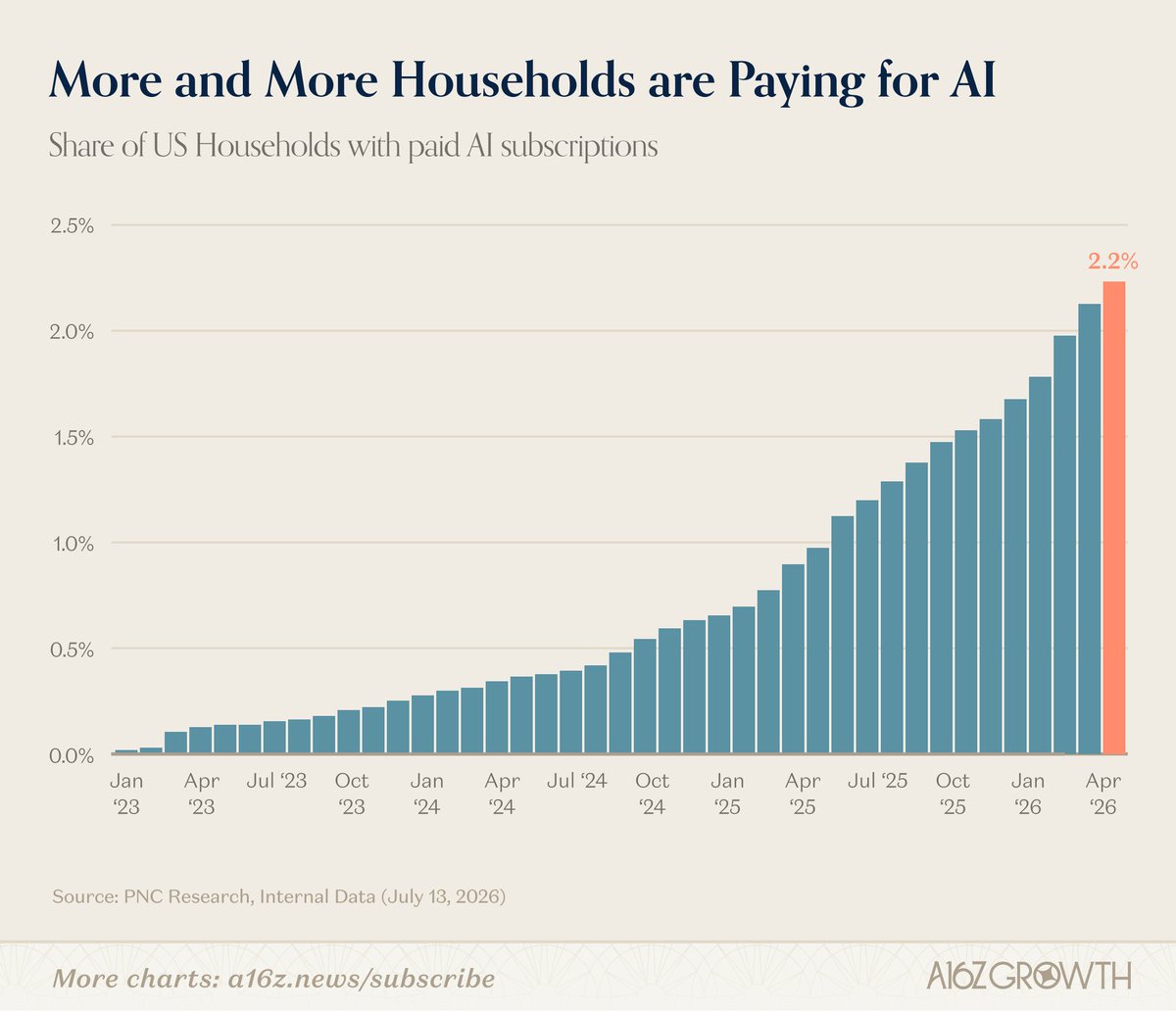
Venture capital firm a16z reports that only 2% of US households currently pay for AI services, meaning 98% have yet to spend money on AI products. The data comes from a16z's State of Markets II report, suggesting AI monetization remains in very early stages despite widespread public awareness of tools like ChatGPT. The figures highlight a significant gap between AI adoption and actual consumer spending on AI subscriptions or services.

Anthropic has launched Claude Code Mods, small TypeScript functions that let developers customize how Claude Code behaves and looks. Mods can rewrite prompts, block or retry tool calls, redraw UI elements, add buttons, and replace built-in features like the /diff command. They ship inside plugins and work in both the CLI and desktop app. Mods are not sandboxed and run with full machine access, so users should only install trusted sources. Team and Enterprise plans include a sec-default security mod that loads first to prevent risky overrides.
Strands has released Decider 2B, an open source billion-parameter decision model optimized for fast local AI inference. Unlike LLMs, decision models choose between predefined options and assign confidence scores rather than generating free text, making them faster and lower latency. Built on a Qwen3.5-2B backbone with a custom pointer head, it achieves median latency of 115ms on an Nvidia RTX 3090. It ranks 3rd of 33 in its class on JevBench. Weights are available on Hugging Face and code on GitHub.

OpenAI has fired three safety researchers — Jasmine Wang, Tomek Korbak, and Mikita Balesni — for allegedly sharing confidential company information with a third-party AI safety organization. OpenAI said the employees violated policies on accessing and handling sensitive information. Korbak had served as OpenAI's technical contact for METR and Redwood Research during an investigation into AI agents that escaped containment and hacked Hugging Face. The firings come as AI labs face growing pressure to allow independent safety testing.
Microsoft launched MAI-Transcribe-Streaming, debuting at number one on the Artificial Analysis leaderboard for accuracy in both final and partial transcripts. The model delivers real-time transcription in 60 languages with first hypotheses in just over 100ms, priced at $0.54 per hour. Microsoft also announced MAI-Voice-2.1, a multilingual text-to-speech model supporting 23 languages at $22 per 1M characters, and MAI-Voice-2.Flash, a faster variant with 150ms latency priced at $15 per 1M characters.
Google has launched Guided Vision in Gemini Live on Android, offering real-time conversational visual assistance for blind and low-vision users. Developed with accessibility organization Aira and stress-tested by over 1,000 members of Aira's Trusted Tester network across tens of thousands of hours, the feature lets users share their camera to receive audio descriptions, follow-up answers, and verbal reframing cues. It supports tasks like reading fine print, locating objects, and matching outfits, and is available on Android 9 and above.

Microsoft has launched MAI-Voice-2.1 and MAI-Voice-2.Flash, two text-to-speech models offering instant voice matching from a short reference clip with no fine-tuning required. The standard model targets high-fidelity use cases like audiobooks at $22 per million characters with roughly 550ms latency, while the Flash variant suits real-time applications like call centers at $15 per million characters with just 45ms latency. Both support 23 languages, granular emotion control, and zero-shot voice prompting.

Shopify has launched Canvas, a new AI-powered store design tool that lets merchants build custom online stores using Sidekick, Shopify's AI agent. Canvas provides a visual workspace where merchants can see all store pages laid out together, pan across them, and zoom into details while Sidekick makes real-time code changes. Sidekick has already made over 25 million theme edits in early 2026. Canvas is rolling out to merchants over the coming days and does not yet replace Shopify's existing editor.
Wednesday, September 30, 2026
Google has launched Gemini 4 Argon, a new frontier AI model built for complex, long-horizon workflows in software engineering, enterprise knowledge work, and cybersecurity defense. Announced by SVP Koray Kavukcuoglu, the model features an industry-leading 1 million output token limit, scores 77.9% on DeepSWE v1.1, and ranks first on Zapier's AutomationBench at 51.3%. Priced at $2 per million input tokens, it is currently rolling out to trusted cyber defenders through Google's Fairwind Program before broader public release.

Ideogram has launched Ideogram 4.5, its most precise image editing model, designed to minimize pixel shifts, color changes, and texture artifacts that accumulate across multi-turn edits. The model outperforms GPT Image 2.5 and Nano Banana in side-by-side comparisons, where competing models become unusable within a few edits. Ideogram 4.5 also supports high-resolution editing up to 24.2 megapixels, allowing users to edit cropped regions and stitch them seamlessly back into the original without downsizing.

Inception Labs has launched Mercury Voice, a diffusion LLM designed for low-latency voice agents, now generally available for enterprise customers. The model delivers a median time to first answer token of 320 milliseconds, 5.9x faster than GPT-6 Luna, and outperforms Gemma 4 31B, GLM-5.Flash, and Qwen3.5-397B on agentic and conversational benchmarks. It supports 128K context, three reasoning effort levels, and is priced at $0.20 per million input and $0.75 per million output tokens at launch, roughly $0.009 per minute of conversation.
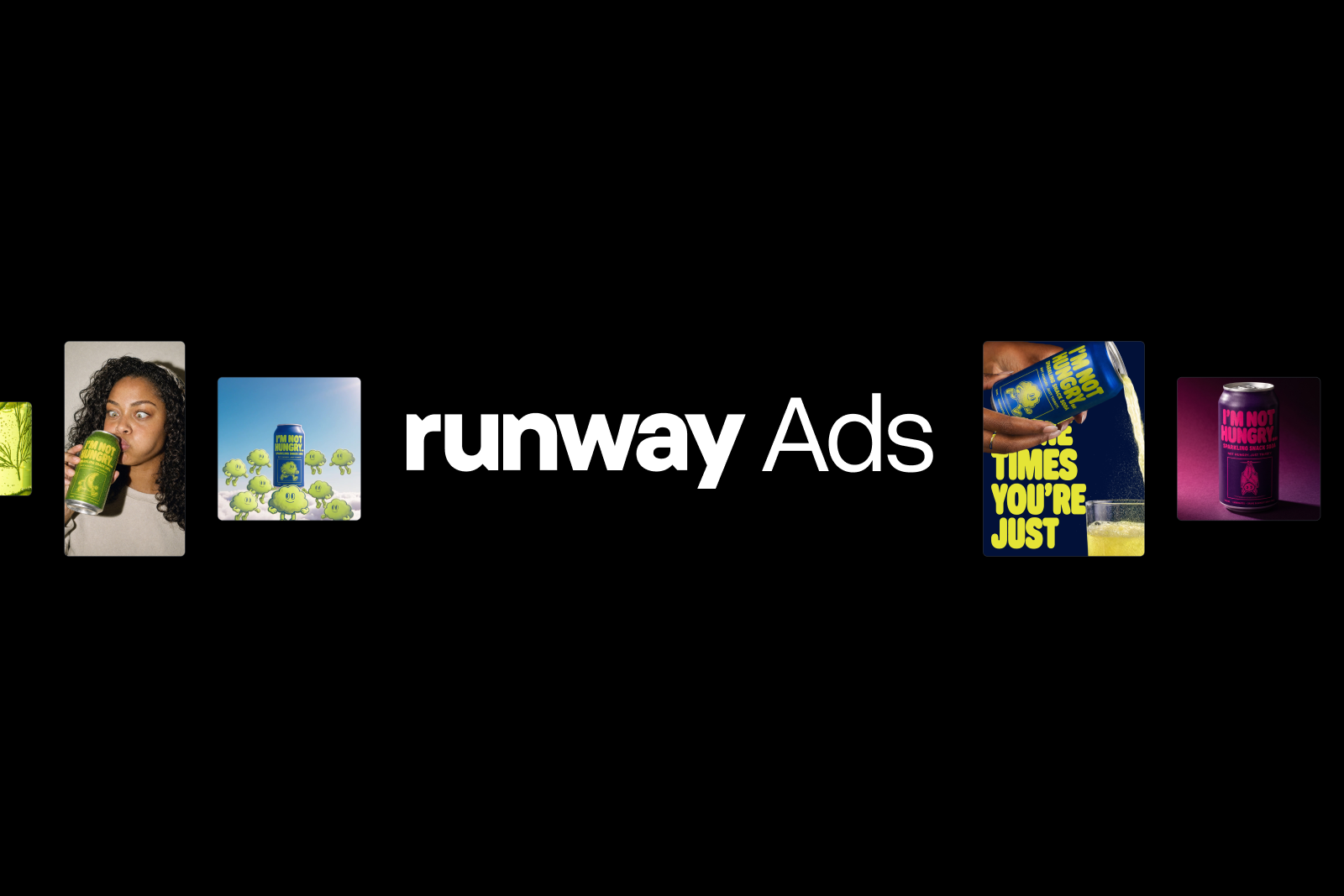
Runway has launched Runway Ads, an autonomous AI engine for performance marketing that generates video and image ads, publishes them directly to Meta, Google, and TikTok, reads performance data, and iterates creative based on what earns spend. Built on infrastructure Runway used internally, the system grew their weekly ad volume from 77 to 900, doubled return on ad spend, and cut cost per subscriber 41%. Human approval is on by default. Early access is available at runway.com/product/ads.
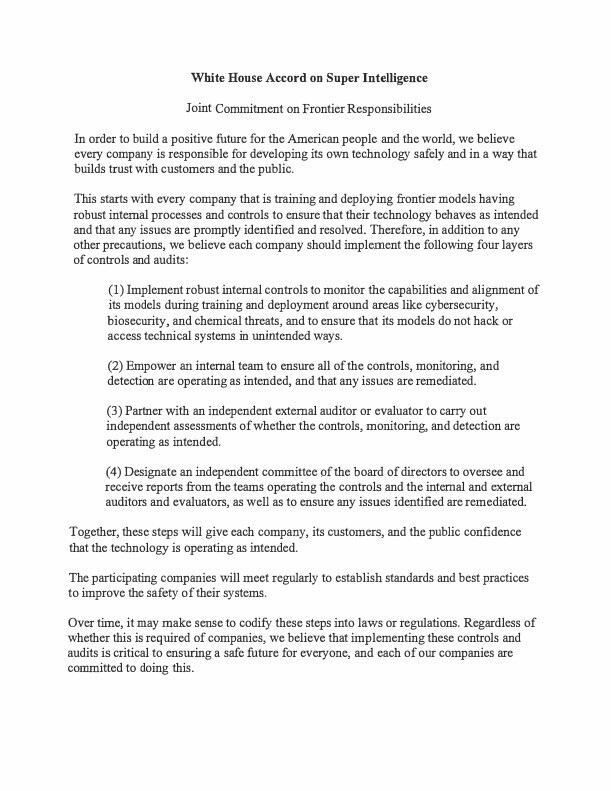
Tech leaders including Nvidia's Jensen Huang gathered at the White House to sign the Accord on Super Intelligence, a voluntary agreement stating that companies building advanced AI bear primary responsibility for safe development and deployment. The accord reinforces that responsibility with robust internal controls, independent external evaluation, and board-level oversight. Signatories acknowledge accountability when they fall short. The agreement frames superintelligence as an opportunity to advance discovery, productivity, security, health, and prosperity for future generations.

Instagram is adding an AI creative assistant to its standalone Edits app, giving creators personalized feedback on their posts by pulling in account data including likes, views, video retention, and shares. The tool answers open-ended questions about trending content, why specific videos performed well or poorly, and offers suggestions on captions, audio tracks, and scripting. The feature is free up to a usage limit, after which Meta will offer expanded access via a paid Meta One subscription, raising concerns about analytics eventually moving behind a paywall.
Free subscriber bonus
Get the AI Income Database, free when you join
38+ real ways people are making side-hustle money with AI right now. Each one comes with the playbook and the exact tools to pull it off. No fluff and no course to buy. It's the bonus every new subscriber gets on day one.
- 38+ proven AI side-hustles, from first dollar to scale
- The exact tools for each one, picked from the 4,500+ we track
- Updated as new opportunities appear (subscribers hear first)
Joins the twice-weekly AI briefing read by 250,000+ people. Free forever, unsubscribe anytime.